9 Best Small Rain Barrels With Spigots (November 2026)
The best small rain barrels with spigots include the FCMP Outdoor Raincatcher 4000 Rain Barrel for most small yards, the Renator Brass Rain Barrel Spigot Kit. Lead-Free for upgrading an old barrel, and the Laspeiraux Collapsible Rain Barrel Water Storage Containers for storing away off-season.
On this page (8 sections)
- The best small rain barrels for tight spaces
- How these small rain barrels compare
- How we compared these barrels
- Which spigot setup suits your yard?
- How much water fits a small footprint?
- Do you need a filter on a small rain barrel?
- How do you set up a barrel in a tight spot?
- Which small rain barrel with spigot should you buy?
The best small rain barrel with spigot for most yards is the FCMP Outdoor Raincatcher 4000, a 50-gallon flat-back barrel whose side spigots let you link a second unit as your watering needs grow. If you already own a barrel with a tired outlet, the Renator brass spigot kit is the smarter buy.
A small rain barrel with a spigot earns its place when the yard is narrow, the downspout sits close to a path, or you want rainwater at hand without a pump. The outlet matters as much as the size, because a low, slow valve turns a full barrel into a chore.
This roundup compares eight compact barrels and one spigot kit on capacity, footprint, outlet height and how easily each one fills a can. Every pick here fits a wall run of about 2 ft or less, so the choice comes down to the job you need it to do.
Our picks at a glance
-
1
 Best for most small yards
FCMP Outdoor Raincatcher 4000 Rain Barrel
9.7/10 our score
See it on Amazon -
2
 Best for upgrading an old barrel
Renator Brass Rain Barrel Spigot Kit. Lead-Free
9.6/10 our score
See it on Amazon -
3
 Best for storing away off-season
Laspeiraux Collapsible Rain Barrel Water Storage Containers
9.5/10 our score
See it on Amazon
- 4
 Check it
Good Ideas Rain Wizard Water Collection Barrel
Best for a tidy front-yard look - 5
 Check it
RTS Home Accents 50-Gallon Newport Rain Barrel
Best for filling watering cans - 6
 Check it
Step2 Lakewood 60-Gallon Barrel with Stand
Best for stronger water pressure - 7
 Check it
FCMP Catalina 45-Gallon Barrel
Best for the smallest footprint - 8
 Check it
Good Ideas Impressions Nantucket Rain Water Collection Barrel
Best for growing herbs on top - 9
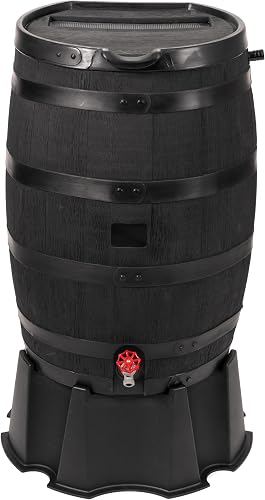 Check it
RTS Premium 55-Gallon Eco Barrel
Best for recycled plastic buyers
The best small rain barrels for tight spaces
The Raincatcher 4000 wins because it pairs a manageable footprint with an outlet you can reach and extend. The other picks each solve one specific problem: a low spigot, a seasonal pack-away, or a barrel that looks good from the street.
If you want the wider picture first, our guide to the best rain barrel for garden covers larger tanks and drip setups.
FCMP Outdoor Raincatcher 4000 Rain Barrel: Best for most small yards
- 50-gallon capacity
- Flat back for wall placement
- Spigots link barrels in series
- UV-inhibited, BPA-free polyethylene
A flat-back 50-gallon barrel that sits flush against a wall and links to a second unit through its side spigots.
Pros
- Flat back hugs a wall
- Side spigots allow linking
- Includes hose, debris screen and overflow tube
Cons
- 50-gallon barrel is heavy when full
- Round body still needs a footprint of about 2 ft square
The Raincatcher 4000 is the pick for a typical suburban yard with one downspout and a few beds to water. Its flat back sits flush against the house, so it tucks into a corner without a round body bulging into the path.
At 50 gallons and 24 in square, it holds enough for about a week of can watering without eating a whole patio. FCMP builds it from UV-inhibited, BPA-free polyethylene, and the body carries a spoke-and-wheel top pattern that keeps children and pets safe.
The wide opening at the top makes the downspout connection quick, and the flat back means the barrel meets the wall with no gap for a hose to snag on.
The side spigots are the feature that sets it apart. They let you run a linking tube to a second barrel in series, so capacity grows without a new downspout.
A 40 in hose, shut-off valve, debris screen and 66 in overflow tube come in the box. FCMP offers a 1-year limited replacement warranty on manufacturing defects.
The trade-off is weight when full. More than 400 lb of water means you want a level, solid base before the first rain, and a spot you won't need to move later.
Renator Brass Rain Barrel Spigot Kit. Lead-Free: Best for upgrading an old barrel
- 3/4-inch quarter-turn ball valve
- Brass bulkhead fitting with washer
- Includes silicone tape and guide
- Reverse-threaded, self-tightening
A complete brass outlet kit that replaces a dripping or slow spigot on a barrel you already own.
Pros
- Full kit with fitting and tape
- Reverse threads stay tight
- Quarter-turn valve opens fast
Cons
- Needs a drill and 1-1/4 inch saw bit
- Only helps if the barrel body is still sound
The Renator kit is the answer when the barrel is fine but the spigot isn't. A 3/4 in brass quarter-turn ball valve opens fully in one twist, so a can fills faster than with a small plastic tap.
The larger flow port takes full advantage of the water pressure sitting in a full barrel.
The bulkhead fitting and spigot are reverse-threaded and tighten from the outside of the barrel, which means no reaching inside with a wrench. A washer, silicone tape and an illustrated guide come in the kit, along with a wire that threads through the drilled hole to guide the fitting down.
That wire trick works on barrels with and without an open top.
You need a drill and a 1-1/4 in saw bit, plus an adjustable or 1 in wrench. That's a 20-minute job on most plastic barrels.
Its score sits just under the Raincatcher because it assumes you have a usable barrel body. For a yard starting from nothing, buy a barrel first and add this only if the included spigot disappoints.
Laspeiraux Collapsible Rain Barrel Water Storage Containers: Best for storing away off-season
- 53-gallon stated capacity
- Three-layer PVC body
- Screw-in faucet
- Mesh top and overflow kit
A foldable barrel that packs down when empty, with a screw-in faucet and circular footpads for stability.
Pros
- Folds down for winter storage
- Screw-in faucet needs no assembly
- Light at about 5.7 lb empty
Cons
- Soft walls depend on the water level for shape
- PVC needs care around freezing weather
The Laspeiraux barrel is for the gardener who packs everything away in November. It's a 53-gallon PVC body that folds flat when empty and weighs about 5.7 lb, so it hangs on a hook in the shed through winter.
That light weight also makes it easy to carry to a downspout before the first fill.
The screw-in faucet arrives as one piece, which cuts the leak points that come from assembling several fittings. Circular footpads under the base stop the soft body from wobbling as it fills, and a mesh top keeps leaves out while an overflow kit sheds the excess.
The three-layer PVC is meant to handle tough conditions, though the soft shell relies on the water inside to hold its round shape.
The trade-off is that soft walls need a level base before they stand well. Set it on flat ground and fill it before you judge how it sits.
For buyers who move house or rent, this is the only pick here that disappears into a cupboard off-season. It's the rain barrel pump pairing we'd suggest if you later want to run a soaker hose from it.
Good Ideas Rain Wizard Water Collection Barrel: Best for a tidy front-yard look
- 50-gallon capacity
- Faux wood finish
- Metal spigot
- Flat back and plastic mesh screen
A textured barrel that reads as wood from the street while still offering a standard metal hose spigot.
Pros
- Faux wood finish hides the plastic
- Flat back for downspout fit
- Light at 19 lb empty
Cons
- Link kit sold separately
- Must be drained and tipped for freezing weather
The Rain Wizard is the barrel to choose when the front of the house is visible from the street or a neighbour's window. Its faux wood texture reads as timber at a glance, so it blends into a fence line better than a plain plastic drum.
The flat back helps it sit tight against a wall.
Behind the finish it's a 50-gallon polyethylene body with a metal spigot for a standard hose. It weighs just 19 lb empty, which makes positioning easy before the first fill.
The plastic mesh screen over the inlet keeps leaves and debris out, and Good Ideas says the plastic resists weather and UV damage.
Good Ideas sells a link kit separately, so plan for that if you want a second barrel. In freezing weather the barrel must be drained and turned upside down or stored indoors.
That winter routine is the main cost of the good looks, since a barrel left full over winter can split when the water expands.
If you want a barrel nobody asks about, this one wins; if you want the simplest possible ownership, the Raincatcher does more out of the box.
RTS Home Accents 50-Gallon Newport Rain Barrel: Best for filling watering cans
- 50-gallon capacity
- Included stand
- Removable lid
- Brass spigot and dual overflow
The stand lifts the spigot toward knee height so a watering can slides under without lifting.
Pros
- Stand raises the outlet
- Removable lid for cleaning
- Overflow nozzle fits either side
Cons
- Tallest pick here at about 44.5 in
- Link kit is an optional extra
The Newport solves the most common small-barrel annoyance: a spigot so low that a watering can won't fit. The included stand lifts the outlet, and the barrel stands about 44.5 in tall in total.
The sturdy base adds stability as well as height, so a full barrel sits squarely on the ground.
A brass spigot handles the daily opening and closing, and the removable lid gives you access for cleaning or filling from a hose. The overflow nozzle can go on either side, which helps when the barrel has to sit with a wall on one flank.
RTS says the body is UV-resistant polyethylene and describes the design as space-saving against walls or fences.
The stand is the trade-off. That extra height needs a level base and about 2 ft of clearance from a window or gutter, and it makes the barrel more visible from a path.
The link kit for a second barrel is an optional extra, so the first barrel's own overflow does the rest. If your knees complain about crouching, the stand is worth it.
Step2 Lakewood 60-Gallon Barrel with Stand: Best for stronger water pressure
- 60-gallon capacity
- Raised stand
- Stainless steel mesh screen
- 3/4-inch brass spigot
The tallest barrel here, with a raised spigot and a double-walled body for a yard that fills fast.
Pros
- Most capacity in this group
- Height adds spigot pressure
- Double-walled plastic resists chipping
Cons
- Heaviest pick at 34 lb empty
- Rectangular body needs a flat, level base
The Lakewood is the barrel for a roof that dumps water fast. At 60 gallons it holds the most of any pick here, and the double-walled plastic body is built to shrug off chipping and fading.
Step2 says the colors won't chip, fade, crack or peel.
Its real advantage is the stand. Raising the spigot adds a little gravity pressure, so a short hose runs with more push and a can fills quicker.
Step2 fits a stainless steel mesh screen that filters fine grit while letting water flow, plus a 3/4 in brass spigot. You can link several barrels together for more storage and managed overflow.
The cost is weight and bulk. At 34 lb empty and 46 in tall, it needs two people and a firm, flat base to set in place.
The rectangular body also needs a level surface, since a lean stresses the seams. For a small yard, check the 24 x 20 in footprint against your wall run before you commit to the biggest option.
FCMP Catalina 45-Gallon Barrel: Best for the smallest footprint
- 45-gallon capacity
- Flat back and fixed lid
- 3.5 ft hose with shut-off valve
- Recycled, BPA-free polyethylene
The narrowest barrel in this roundup, sized for a strip beside a garage or a narrow side path.
Pros
- Smallest footprint here
- Fixed lid keeps kids and pets out
- Includes a short hose and shut-off valve
Cons
- Smaller capacity than most picks
- No wide opening for reaching inside
The Catalina is for the narrow strip of ground beside a garage or the gap along a side path. At 22.5 x 20.5 in it has the smallest footprint here, and the 45-gallon body still covers a week of bed watering.
Its smooth curves and rounded edges mean it looks tidier against a wall than a plain drum.
FCMP makes it from recycled, UV-inhibited, BPA-free polyethylene. The fixed lid keeps children and pets out, which matters on a route where kids pass.
A 3.5 ft hose with a thumb shut-off valve lets you fill a can without crouching at the spigot. The flat back lets it meet a downspout without a gap.
The trade-off is capacity and access. You give up 5 gallons against the Raincatcher, and the small fixed opening means you clean through the spigot side rather than reaching in.
For a yard where every inch counts, that's a fair swap. If you have room for 24 in square, the Raincatcher's linking spigots are worth the extra width.
Good Ideas Impressions Nantucket Rain Water Collection Barrel: Best for growing herbs on top
- 50-gallon capacity
- 4-inch planter top
- Two metal spigots
- Mesh screen and routed overflow
The lid doubles as a small planter, so the barrel earns its space twice in a tight garden.
Pros
- Planter top adds growing space
- Two spigots for a hose and a bucket
- Overflow routed to the front
Cons
- Planter top needs its own watering
- Round body takes about 2 ft square
The Nantucket gives the barrel a second job. Its 4-inch planter top holds herbs or small flowers, so the space it takes up grows something besides a plastic drum.
A dark brown finish helps it sit quietly in a border.
Under the lid it's a standard 50-gallon polyethylene barrel with a mesh screen for debris. Two metal spigots are the useful part: a front outlet for a hose and a side tap for filling tall buckets or linking a second barrel.
A routed channel sends overflow to the front of the barrel, away from the house wall and the foundation.
The planter top needs watering of its own, which is a small irony in a water barrel. And the round 23.25 in body still takes a full 2 ft square of ground.
The dual spigots also mean the barrel earns its keep as a hose source, not just a can filler. Choose it when looks and growing space beat a flat back against the wall.
RTS Premium 55-Gallon Eco Barrel: Best for recycled plastic buyers
- 55-gallon capacity
- Made from 100% recycled plastic
- Flat back and removable lid
- Stand included
A flat-back barrel built from recycled resin, with a raised spigot and a lid you can lift off.
Pros
- Body uses 100% recycled plastic
- Stand raises the spigot
- Removable lid for cleaning
Cons
- Plastic spigot rather than brass
- Slim track record compared with older designs
The Eco Barrel is for the buyer who wants the plastic itself to count. RTS makes the 55-gallon body from 100% recycled resin, so the barrel that saves water also reuses material.
A UV-resistant finish helps it last outdoors.
The flat back lets it sit against a wall or fence in tight spots, and a removable lid makes cleaning and water retrieval simple. A stand comes with it, raising the spigot so a can fits underneath, and the screened inlet keeps debris and insects out.
An integrated overflow sends excess water away from the house.
It's the second-largest capacity in this group behind the Lakewood, at 55 gallons. The main compromise is the spigot.
It's plastic rather than brass, so if you want a longer-lived valve, pair it with the Renator kit down the line. Its track record is shorter than the older designs here, which is why it sits last on the list despite the sensible spec sheet.
How these small rain barrels compare
The table lines up capacity, footprint and the spigot setup so you can see which barrel actually fits your wall. The tallest barrels give the easiest can filling; the smallest bodies save the most ground.
| Product | Best for | Capacity | Size (L x W x H) | Material | Our score |
|---|---|---|---|---|---|
| FCMP Outdoor Raincatcher 4000 Rain Barrel | most small yards | 50 gallons | 24 x 24 x 32 in | Polyethylene (PE) | 9.7 |
| Renator Brass Rain Barrel Spigot Kit. Lead-Free | upgrading an old barrel | Brass | 9.6 | ||
| Laspeiraux Collapsible Rain Barrel Water Storage Containers | storing away off-season | 53 gallons | 23.62 x 23.62 x 27.56 in | PVC blend | 9.5 |
| Good Ideas Rain Wizard Water Collection Barrel | a tidy front-yard look | 50 gallons | 23 x 22 x 30 in | Polyethylene (PE) | 8.9 |
| RTS Home Accents 50-Gallon Newport Rain Barrel | filling watering cans | 50 gallons | 22.7 x 21.7 x 44.5 in | Polyethylene (PE) | 8.0 |
| Step2 Lakewood 60-Gallon Barrel with Stand | stronger water pressure | 60 gallons | 24 x 20 x 46 in | Plastic | 7.9 |
| FCMP Catalina 45-Gallon Barrel | the smallest footprint | 45 gallons | 22.5 x 20.5 x 29.75 in | Polyethylene (PE) | 7.9 |
| Good Ideas Impressions Nantucket Rain Water Collection Barrel | growing herbs on top | 50 gallons | 23.25 x 23.25 x 32 in | Plastic | 7.6 |
| RTS Premium 55-Gallon Eco Barrel | recycled plastic buyers | 55 gallons | Flat back, stand included | Recycled plastic | 7.5 |
How we compared these barrels
We scored each pick on capacity per square foot of ground, spigot height and valve type, and how easily the barrel links to a second unit. Each model's specs came from the maker's own product data.
Barrels with a flat back and a reachable outlet scored higher than round bodies with low taps. A barrel that includes a stand, a screen and an overflow tube saves money and setup time, so those features lifted the score.
We also weighed seasonal ownership: can the barrel be drained and stored, and does the winter routine ask the owner to tip a heavy drum. The collapsible Laspeiraux scored well on that point alone.
The scores reflect what a small-yard buyer needs, not raw capacity alone.
One line explains the numbers: our score weighs specs, features and buyer feedback against what you're shopping for.
Which spigot setup suits your yard?
The spigot decides how pleasant the barrel is to live with. A quarter-turn brass valve at can height beats a plastic tap near the ground, whatever the capacity.
Where should the spigot sit?
Place the spigot so a watering can slides under it without lifting. That means a raised barrel, either on a stand or on blocks, with the outlet at least a few inches above the base.
The Newport and Lakewood include stands for this reason. With a low barrel, a short length of hose does the job instead.
Check the outlet height against your tallest can before you buy.
Brass or plastic?
Brass with a ball valve holds a seal longer and opens in a quarter turn. Plastic spigots work fine on a budget barrel but are the first part to wear.
The Lakewood and Newport both use brass; the Eco Barrel uses plastic.
If the body is sound and the tap drips, the Renator kit fixes the problem for the price of a fitting set rather than a new barrel. That makes the outlet the cheapest upgrade on a barrel you already like.
How much water fits a small footprint?
A 45 to 60-gallon barrel holds roughly 4 to 6 days of watering for a few vegetable beds, depending on weather. Capacity matters, but so does the footprint you can spare.
Taller, narrower bodies fit a tight wall run; wider, round ones take more ground for the same volume. Use our guide to how much water a rain barrel holds to work out your own weekly need before you size the barrel.
One barrel or two?
One 50-gallon barrel covers a couple of beds. A second barrel linked in series doubles the supply and captures a downspout's overflow, which is why side spigots on the Raincatcher 4000 matter.
The Nantucket's second spigot and the Newport's dual overflow serve the same purpose.
Linking needs a tube and a level base, so check the barrel's link kit before you buy a second unit. On the Rain Wizard and Newport the link kit is sold separately, so factor that in.
Where does the water go when it's full?
Overflow is the detail people forget. A full barrel during a storm sends water straight down the wall unless an overflow tube carries it away.
Look for a barrel with an overflow port you can aim at a bed, a gravel strip or a drain. The Raincatcher 4000 includes a 66 in overflow tube for this.
The Nantucket routes its overflow to the front of the barrel, and the Newport lets you fit the nozzle on either side.
Do you need a filter on a small rain barrel?
Yes, at least a mesh screen, because leaves and grit from the roof will clog the spigot and cloud the water. Most barrels here include a screen over the inlet.
The Lakewood goes further with a stainless steel screen that traps fine particulate.
A finer filter helps if you plan to run a pump or drip line from the barrel. Our guide to whether you need a rain barrel filter covers the screen versus filter choice.
Screen, diverter or both?
A screen over the inlet catches leaves, but a downspout diverter keeps the first flush of dirty roof water out of the barrel entirely. In a small yard the diverter also lets you shut off flow in winter without hauling the barrel around.
Pair one with the screen for the cleanest water.
How do you set up a barrel in a tight spot?
Set the barrel on a level, solid base beside the downspout, cut the downspout to suit, and point the overflow away from the foundation. A full barrel is heavy, so the base and the fall of the ground matter.
Checking the base
Compacted gravel, paving slabs or a purpose-made stand all work. Avoid soft soil, which lets a full barrel lean and stresses the seams.
A full 50-gallon barrel weighs more than 400 lb, so the base has to carry that load without sinking.
Connecting the downspout
A flexible downspout diverter makes the job clean and lets you shut off flow in winter. Measure the downspout size before ordering one.
The flat-back barrels here sit flush to the wall, so the diverter feeds the inlet with a short run of pipe.
Running a pump or hose
If the barrel sits low or far from the beds, a pump moves water uphill and along a soaker line. Our pick of rain barrel pumps covers the small models that suit a 50-gallon barrel.
A raised barrel like the Newport or Lakewood gives gravity a head start, so you may get by without one.
Which small rain barrel with spigot should you buy?
Buy the FCMP Outdoor Raincatcher 4000 for most small yards. Its flat back and linking spigots give you room to grow, and the included hose, screen and overflow mean it works on day one.
The 50-gallon body is the best balance of capacity, footprint and outlet reach here.
Pick the Renator brass kit if your barrel body is sound and only the spigot fails. Choose the Laspeiraux if you need the barrel gone by winter, the Newport if you want the tap raised for cans, and the Catalina if the gap is truly narrow.
The Lakewood suits a roof that fills fast, and the Eco Barrel suits buyers who want recycled plastic.
Whatever you choose, size it to your beds and keep the spigot reachable. A small rain barrel with spigot earns its keep on a week of watering, not on being the biggest drum on the street.
Our top 3 picks at a glance
-
1
Best for most small yards
FCMP Outdoor Raincatcher 4000 Rain Barrel
9.7/10 our score
See it on Amazon -
2
Best for upgrading an old barrel
Renator Brass Rain Barrel Spigot Kit. Lead-Free
9.6/10 our score
See it on Amazon -
3
Best for storing away off-season
Laspeiraux Collapsible Rain Barrel Water Storage Containers
9.5/10 our score
See it on Amazon
Frequently asked questions
Do I need a stand under a small rain barrel?
A stand lifts the spigot so a watering can fits underneath and gravity feeds a hose better. The RTS Newport and Step2 Lakewood include one.
With a barrel that sits low, plan on filling cans from a short spout or adding a pump.
Where should a small rain barrel go?
Put it on flat, solid ground beside a downspout, on the shaded side of the house if you can. A full 50-gallon barrel weighs more than 400 lb, so a level base matters more than the exact spot.
Keep the spigot side clear for cans and hoses.
Will one small barrel fill my garden?
A 50-gallon barrel covers roughly a week of watering for a few beds, not a whole lawn. Use our guide to how much water a rain barrel holds to size yours.
Linking two barrels doubles the supply without a second downspout.
What is the difference between a brass and a plastic spigot?
A brass spigot with a ball valve, like the Renator kit, opens in a quarter turn and holds a seal over many seasons. Plastic spigots work fine but wear faster.
On a barrel you plan to keep, the outlet is the part most worth upgrading.
Can a rain barrel with a spigot stay out in winter?
Drain it before the first hard freeze and store it upside down or indoors. Water left in a full barrel expands as it freezes and can split the body or push out the spigot.
A collapsible barrel folds away for the season instead.


