Best Rain Barrels for Rain Chains: How to Choose
The best rain barrel for a rain chain is a flat-back barrel with a removable or screened lid and a real overflow outlet you can route away from the house. The RTS 50-Gallon Oak Brass Spigot Barrel is the pick for most chains because its flat back sits close to the wall and its screen catches debris before the water settles.
On this page (11 sections)
- What makes a good rain barrel for a rain chain?
- Which barrel fits under a chain at the wall?
- When is the larger RTS barrel the better pick?
- How do you set a rain chain over a barrel?
- Does the barrel size match the chain and the roof?
- Which top design sheds leaves best?
- Do you need a stand under a chain-fed barrel?
- How do you keep the water clean and usable?
- Does a rain chain barrel earn its place in the garden?
- Should the chain end in a barrel or a drain?
- Which barrel should you pick for your rain chain?
The best rain barrel for a rain chain is one with a wide, screened top opening and a flat back that sits close to the wall. That way the chain ends just above the lid, water lands inside instead of splashing behind the barrel, and leaves stay out of the stored water.
Most chains drip in one steady stream, so the barrel does not need a fancy inlet. It needs a lid you can open, a screen that catches debris, and an overflow that sends storm water away from the foundation.
This guide walks through those points and names the two barrels we would pair with a chain.
What makes a good rain barrel for a rain chain?
A good barrel for a chain catches the drip in a screened opening and lets the overflow escape. The chain itself only moves water downward, so the barrel does the collecting and the storm handling.
Three features matter more than capacity at first. The top opening has to accept the chain's position, the lid has to shed leaves, and the overflow outlet has to reach away from the wall.
A flat back helps on tight patios because the barrel sits flush under the chain rather than on a round curve that leaves a gap.
Capacity comes next. A 50 to 55 gallon barrel covers most garden watering between storms, and the math depends on roof area.
Read how much water does a rain barrel hold to size the barrel against your roof and rainfall before you commit to a spot under the chain.
The spigot should sit low enough for a watering can and high enough that a stand is optional. A brass spigot with a hose thread gives you a second way to draw water when the can is too slow.
Pick a flat-back barrel with a workable lid and a front overflow; skip any barrel whose overflow would dump water against the house.
Which barrel fits under a chain at the wall?
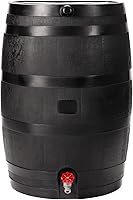
The RTS 50-Gallon Oak Brass Spigot Barrel is the best fit for most rain chains at a wall. Its flat back sits snugly against siding or a fence, so the chain hangs a few inches from the surface and water lands inside the lid area.
The oak finish reads as a wooden barrel without rot, and the molded texture holds its color outdoors. A screen over the inlet keeps debris out, which matters when a chain carries leaves down with the water.
The overflow valve manages excess water, and a front-side overflow keeps the flood away from your outside wall. You can link a second barrel for more storage if one chain delivers a lot of water.
The spigot sits fairly low, so an optional stand makes filling watering cans easier. That stand also lifts the lid, which helps if your chain ends high.
Choose it for a tight wall spot under a single chain. It is the simplest barrel to set up and the one most chains will feed cleanly.
When is the larger RTS barrel the better pick?
The RTS Premium 55-Gallon Woodgrain Barrel suits a rain chain on a long wall where you want a lid you can lift fully. A removable lid is the main advantage: you can open it to clean the barrel or reach the water without working around a fixed top.
Its flat back fits against a wall or fence like the 50-gallon model. The woodgrain with black stripes gives it a different look, and the UV-resistant resin holds up to sun.
The included aluminum screen and hose barb help with setup, and the overflow system directs extra water safely. A brass spigot keeps the draw point leak-free.
Because the lid comes off, this is the easier barrel to drill or adapt if you want to run the chain through a custom opening instead of resting the drip over the screen. A conventional chain that ends above the lid works just as well here.
Choose it when access and adaptability matter more than the oak look, or when an extra 5 gallons helps between fill-ups. It is the larger of the two barrels and the one to pick for a lid you can open.
How do you set a rain chain over a barrel?
Set the chain so its end hangs 2 to 4 inches above the barrel's lid or screen, then check it in the first real rain. Too short and splash escapes; too long and the chain can swing into the screen or clog the opening.
Start with the barrel in place and level. A full barrel is heavy, so put it on a solid, even base before you fill it.
A stand raises the spigot and the lid together, which solves two problems at once.
Hang the chain so the bottom link lines up over the center of the lid or the inlet. Leave room for wind: a chain that touches the lid can rattle and shed water sideways.
On a barrel with a screen, the water passes through the mesh and debris stays on top. Clean the screen after heavy leaf fall.
If you plan to store water for a long time, a rain barrel filter before the tank keeps fine grit out and cuts cleaning.
Route the overflow with a short hose or a splash block toward a garden bed. Never aim it at the foundation, a walkway that ices over, or a neighbor's property.
Check the drip in the first storm and adjust the chain length before you trust it for the season.
Does the barrel size match the chain and the roof?
A barrel size matches a chain when it holds one good storm's runoff from that roof section. A chain typically serves a small roof area, so 50 gallons often covers it, but a steep roof or a wide gutter run can fill the barrel fast.
Use the chain's position to estimate the roof area it drains. A foot of gutter with a 20-foot roof slope sends far more water than a short run over a porch.
Multiply roof area by rainfall depth for a rough volume, then round up.
Two barrels linked together give you double the storage with one overflow chain. The RTS 50-gallon model supports linking, and the 55-gallon barrel handles its own overflow through the included system.
If you plan to water the garden with a hose, a rain barrel pump moves water uphill or across the yard faster than gravity. A pump also empties the barrel before the next storm, which leaves room for runoff.
Pick the barrel that holds at least one storm's worth of water from the chain's roof area, and add a second barrel if the chain is busy.
Which top design sheds leaves best?
A screened flat lid sheds leaves best because water passes through and debris stays on top where it dries and blows off. A closed lid with a small inlet works for a chain too, but the inlet must sit right under the drip.
The 50-gallon barrel uses a screen over its inlet, so leaves that travel down the chain collect above the water rather than sinking. The 55-gallon barrel uses an aluminum screen over its opening with a removable lid around it.
Either design keeps mosquitoes from laying eggs in open water, which is why a screen is more than a convenience. Standing water without a cover breeds insects within days in warm weather.
For a chain that carries a lot of twigs, clean the screen after each big storm. A clogged screen sends water over the side, and that is the failure mode to watch.
If you cut a custom hole for the chain, keep it narrow and screen it. A wide open top lets raccoons and birds in and gives leaves a direct path to the water.
Choose a screened or removable lid, then keep the screen clear after storms; an open top cancels the benefit of the chain.
Do you need a stand under a chain-fed barrel?
A stand is worth it when the spigot sits too low for a watering can, and it also raises the lid closer to the chain's end. The RTS barrels both offer an optional stand sold separately, and a stand solves the two common complaints at once.
A full 50-gallon barrel weighs a lot, so the stand must be rated for the load and sit on level ground. Never stack a barrel on blocks or a wobbly platform.
Water weight shifts and a tipped barrel makes a mess and can hurt someone.
If you skip the stand, make sure a can or bucket slides under the spigot with the barrel on its base. The 50-gallon barrel's spigot sits low, so check before you fill it.
A stand also lifts the overflow outlet, which helps when you want the overflow to reach a garden bed. Gravity does the rest.
Plan the stand before you set the chain height, because lifting the barrel changes how far the chain has to reach.
How do you keep the water clean and usable?
Keep barrel water usable by letting the screen catch debris, emptying the barrel between storms, and drawing from the spigot rather than dipping a can. Stored rainwater is fine for plants and washing tools, and clean handling keeps it that way.
The first flush off a roof carries dust and bird droppings. A diverter or filter before the barrel sends that first water elsewhere.
A rain barrel filter also keeps grit out of the spigot and the watering can.
Do not drink barrel water. Use it on gardens, lawns and outdoor cleaning, and keep it away from anything you eat raw without washing.
Empty the barrel before a hard freeze. Ice expands and can split rigid plastic.
Drain both barrels and remove or tie up the chain until spring.
Treat the screen and the overflow as the two parts to check after every storm; the rest of the barrel needs little attention.
Does a rain chain barrel earn its place in the garden?
Yes, a chain-fed barrel earns its place when the garden is close to the chain and the water gets used. A barrel that fills and sits for weeks is storage without a purpose, and a barrel that overflows onto the wall is a problem.
Pair the barrel with a watering routine. The spigot fills cans for beds near the house, and a rain barrel pump covers a hose run to the back garden.
For a bigger growing setup, our roundup of the best rain barrel for garden use covers larger tanks and linked systems.
The oak-textured barrel fits a cottage or rustic garden, and the woodgrain version suits a fence line. Both look better than a bare tote under a chain.
The third item in our product list is a different kind of garden helper. If you also compost kitchen scraps, the Wormie's Home 4-Tray Worm Composter gives you a compact bin for a corner of the yard.
Pair the barrel with a use for the water, or the chain becomes decoration with a tank under it.
Should the chain end in a barrel or a drain?
A barrel is the better choice when you want the water for the garden and can use it between storms. A drain is better when the roof area is large, the ground slopes away naturally, or the barrel would fill faster than you can empty it.
A chain over a barrel makes sense on a porch, a small outbuilding or a section of gutter that serves a bed. It makes less sense on a big roof where one storm fills a 55-gallon barrel in minutes and the overflow does most of the work.
If the barrel overflows often, link a second barrel or move to a larger tank. Our guide to the best rain barrel for garden use covers bigger options, and how much water does a rain barrel hold helps you pick a size for the roof.
The chain still adds value either way: it slows the water and directs it to one point instead of a sheet off the gutter.
Match the barrel to the roof area; if it fills in every storm, the chain needs a bigger tank or a second barrel.
Which barrel should you pick for your rain chain?
Pick the RTS 50-Gallon Oak Brass Spigot Barrel for most wall-mounted chains, because its flat back and screened inlet take the drip cleanly and its dual overflow keeps water off the house. Choose the RTS Premium 55-Gallon Woodgrain Barrel when you want a removable lid, the extra 5 gallons, or an easier top to adapt.
Both barrels are flat-back designs that sit close under a chain, and both come in at 50 gallons or more. Set the chain a few inches above the lid, route the overflow away from the foundation, and clean the screen after heavy leaf fall.
The simple rule: buy the barrel that matches your wall space and your ability to use the water, then set the chain to feed it. If the roof above the chain is large, add a second barrel or a pump before the first storm tests your setup.
Frequently asked questions
How does a rain chain feed a barrel?
Water runs down the chain and drips off the bottom into whatever sits under it. A barrel with a screened inlet or a flat lid catches that drip, and the chain ends just above the lid so wind does not swing it clear.
Can a rain chain block a barrel inlet?
A chain hanging through a closed lid opening can clog with leaves and slow drainage. Use a screened inlet wide enough to take the chain's drip, or end the chain a few inches above a flat lid so debris stays out.
How full should a rain barrel be before a storm?
Empty it or leave about a quarter of the volume free before heavy rain. A 50-gallon barrel fills fast from a typical roof, and the overflow outlet only helps if water has somewhere to go.
Do rain chains work in cold weather?
Freezing water can split a plastic barrel and crack a chain cup. Drain the barrel and remove or tie up the chain before temperatures drop to freezing, then set both up again in spring.
Should a rain barrel sit on the ground or a stand?
A barrel needs a level, solid base. A short stand lifts the spigot so a watering can fits underneath, and it also raises the lid closer to the end of the chain.